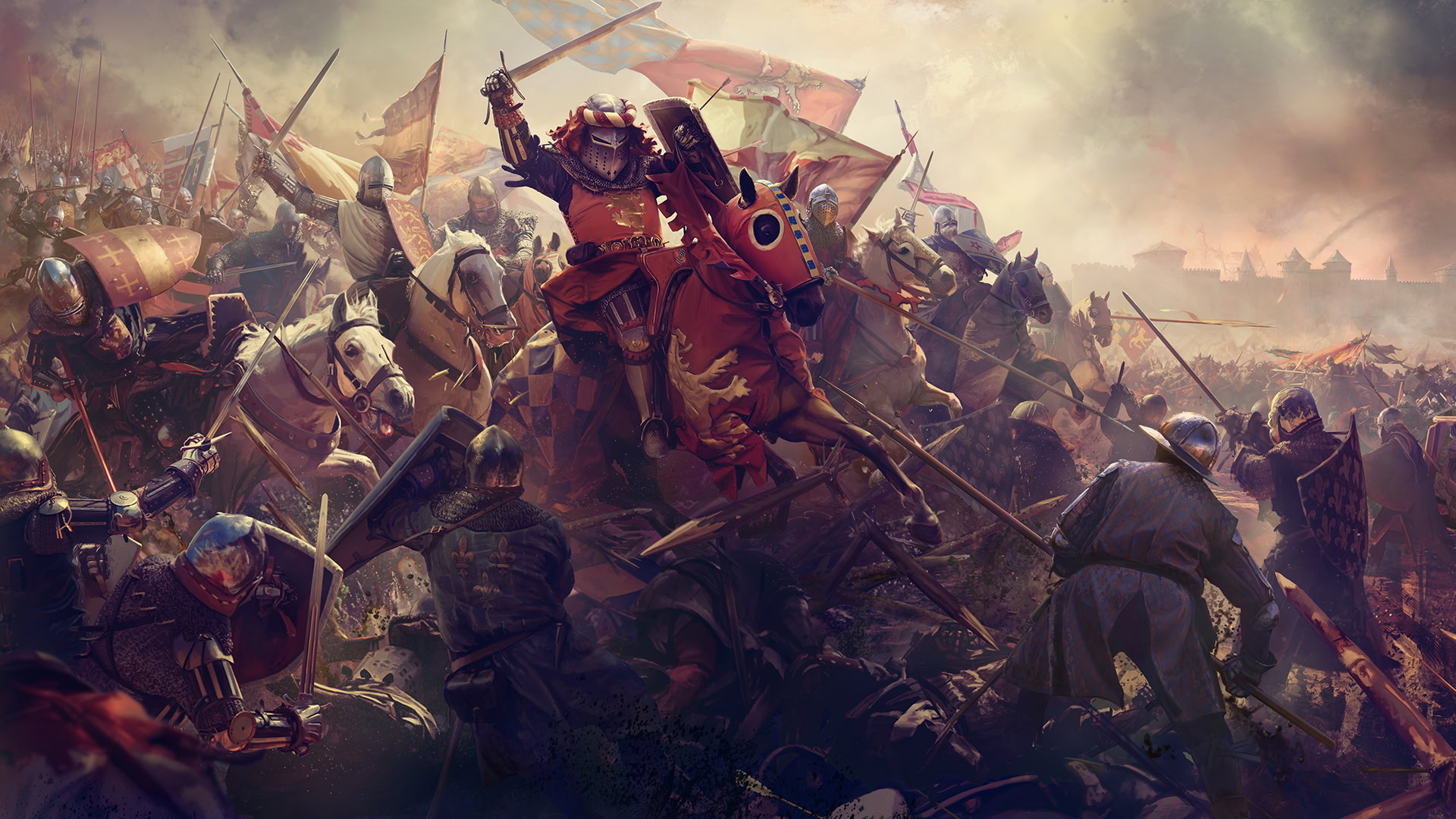
Today, Chronicles: Medieval showcased its massive medieval sandbox through its Exploration Map, the central hub connecting the game’s strategic overworld with its third-person battles and tactical encounters.
Spanning a recreation of 14th-century Europe across the British Isles, France, and the Holy Roman Empire, the map in Chronicles: Medieval contains 209 individual regions filled with settlements, castles, armies, merchants, bandit camps, and other dynamic points of interest. The Exploration Map draws heavily on historical cartography, with the British portion of the world inspired by the Gough Map, a well-known surviving map of Great Britain dating to the mid-14th century.
Rather than presenting the entire world and everything occurring within it from the start of a campaign, Chronicles: Medieval uses a layered Fog of War system that emphasizes exploration, reconnaissance, and keeping information current. Regions that players have never visited remain obscured until they are explored for the first time, while previously discovered locations remain visible after the player moves away.
Information within those regions will gradually become outdated, meaning the geography may remain known while the political and military situation continues developing beyond the player’s immediate view. Returning to an area after spending considerable time elsewhere could therefore reveal changes such as newly established bandit camps, traveling merchants, or enemy forces moving through the region.
Only locations within the active scouting range of the player’s party provide completely up-to-date information, requiring players to physically position themselves near an area if they want accurate intelligence about troop movements and nearby opportunities. The broader campaign combines strategic systems reminiscent of games such as Mount & Blade: Bannerlord, Total War, and Crusader Kings III, while letting players directly participate in events unfolding across the map.
Traveling parties can encounter armies or other threats before transitioning from the top-down Exploration Map into detailed third-person environments where players fight alongside their soldiers during field battles and sieges. Starting an encounter also introduces a deployment phase that lets an army organize before combat begins. Soldiers can be automatically assigned to different portions of the formation based on their role and cultural preferences, including vanguard, main battle, rear guard, and flank positions.
Those distinctions can affect how different armies are structured, with French cavalry potentially favoring positions toward the front of a formation while English longbowmen can be deployed along the flanks. The system is designed to make an army’s composition and cultural background an important part of preparing for an encounter, rather than having every force operate with an identical battlefield layout.

Army growth will also work differently from systems that require players to recruit an increasing number of separate squads. As the player character progresses, the baseline number of soldiers that can belong to individual units increases, allowing established formations to grow into groups of up to 100 troops.
Chronicles: Medieval is also being built around a multigenerational campaign rather than the lifespan of a single protagonist. When the player’s current character dies, control can pass to another member of the dynasty, letting the campaign and its evolving political landscape continue across generations.
Combined with the Exploration Map’s changing settlements, military movements, Fog of War, and large-scale regional structure, the system is intended to create a sandbox where players gradually build their own medieval history rather than following a predetermined campaign. The result connects long-term dynastic progression and strategic decision-making with battles fought directly from a third-person perspective as control of 14th-century Europe continues to change around the player.
Chronicles: Medieval is scheduled for PC via Steam in 2026. The sandbox RPG emphasizes historical accuracy, regional autonomy, and complex, AI-driven economic and military systems.
For more information on this and other upcoming medieval simulators coming out in 2026, like The Guild – Europa 1410, be sure to check back to Simulation Daily for updates