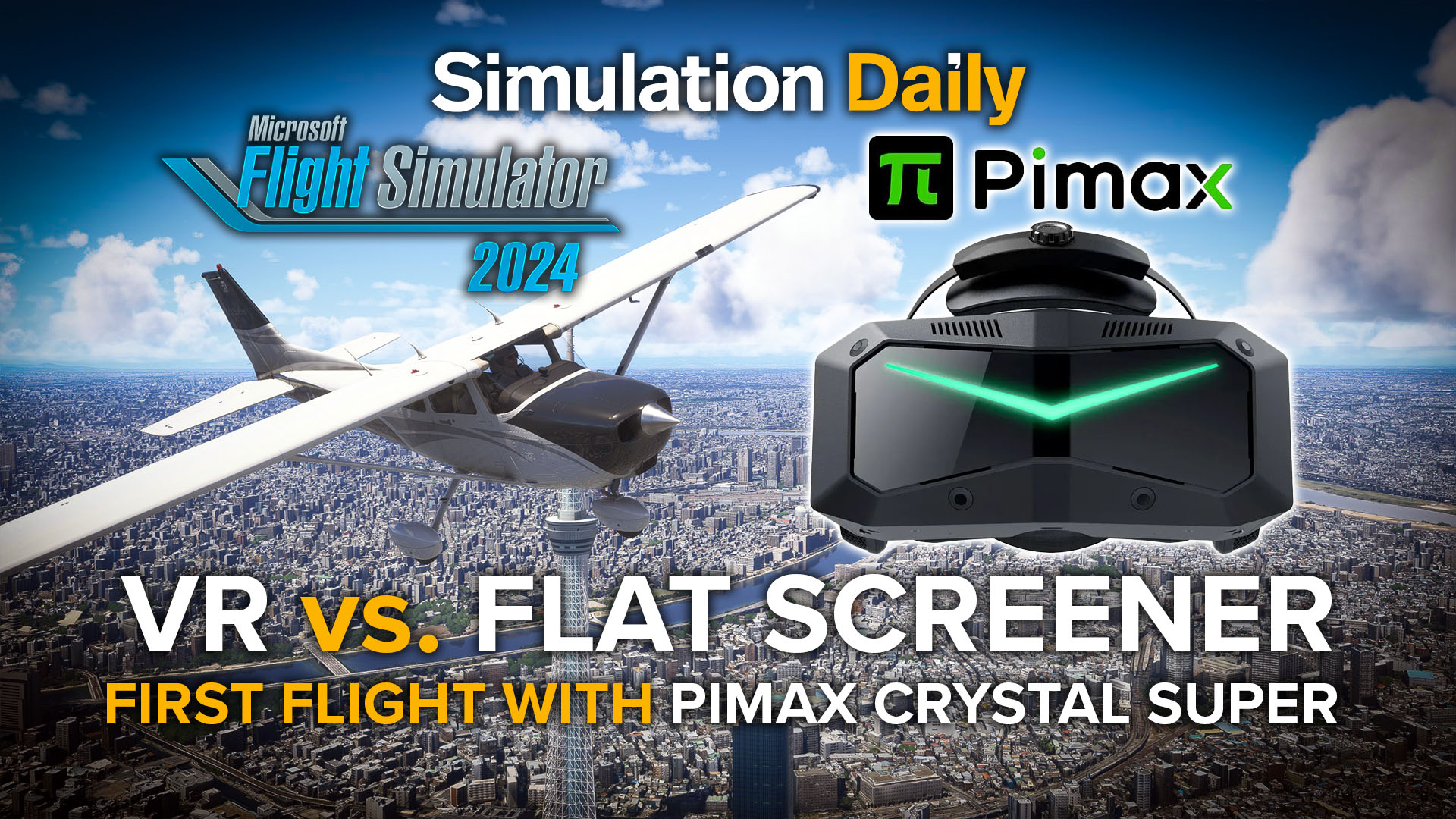
We flew in Microsoft Flight Simulator 2024 with a Pimax Crystal Super 57 PPD virtual reality headset, but can it convince a hardcore flat screen enthusiast that VR is ready for prime time?
Virtual reality has been a polarizing topic for the longest time, with many swearing by it, while the other half of the sky dismisses the technology as clunky and Immature.
Personally, I have been part of the second camp pretty much forever. It’s not because I’m not interested, but the vast majority of the experiences I’ve had in the past were either disappointing or mediocre at best, and with my job as a gaming journalist, I’ve tried tons of games and headsets at a variety of events.
None of them really impressed me. Either the games lacked depth, or the headset lacked clarity, response, performance, etc. It never really worked for me until a few weeks ago.
At FS Weekend in Lelystad, I finally tried Microsoft Flight Simulator 2024 with PlayStation VR2, and it just worked. I didn’t have to waste time setting anything up or playing with the settings. It was just a plug-and-play experience, which solved one of my main gripes with the technology, which is that I had to spend way too much time playing around with settings to get something workable.
While I have the PS5 version of Microsoft Flight Simulator 2024, it’s not my daily driver. I fly mostly on the PC version, so the PS VR2 isn’t really the solution that works for me.
Yet, it made me think. If VR technology has progressed so much that I can actually enjoy the simulator on a machine that’s as relatively underpowered as a PS5, could today’s PC VR tech grant me the experience I require without having to compromise on visuals too much?
That was my other big issue. I have a fairly powerful PC, and you can read the exact specs below, but I am not willing to sacrifice too much of that power and the visuals it grants, just to run VR. Having to make too many compromises with the graphics settings has always turned me off.
Experiencing new technology like Foveated Rendering in conjunction with frame generation has given me hope that a cutting-edge PC headset can grant me a pretty smooth experience without having to accept many compromises.
That’s when Pimax contacted me, offering to let me test one of their Crystal Super headsets, which gives me exactly what I needed to answer that question, considering that it comes with dynamic foveated rendering and all these bells and whistles, which could put less strain on my hardware while hopefully providing a good experience.
For the sake of full disclosure, as I mentioned, the headset used in this video is provided by Pimax. We’re not getting to keep it, as it’s a loaner for 3 months, so we’ll test it thoroughly and then send it back.
This is not a review. As usual with us, we don’t believe in reviews. In this and likely more videos, we’ll test the headset and tell you what we think, completely raw and unscripted. As you know, we believe in giving you the knowledge you need to make your own purchasing decisions instead of telling you whether you should or shouldn’t buy something.
If you get to the end of the video wanting to buy a Pimax headset, great. You can purchase it here by using the promotional code “orbx” for a 2% discount and a $150 accessory bundle if you want. This is an affiliate link, and it will result in a commission. If that’s not the case, we’re still glad that we helped you make an informed choice.
As a matter of fact, this flight and the video don’t have the purpose of convincing you to buy a headset. The real purpose is to convince me, a hardcore flat-screener, that I shouldn’t stick this headset back into its box and send it back to Pimax right now.
Basically, if this experience can convince me that VR has matured enough to provide me with an experience that is both enjoyable and immersive, without forcing me to make too many compromises or to have to tweak the settings too much to the point that it becomes tedious, I’m going to go deeper into the rabbit hole and create more content.
You can watch the video below and hear exactly how I felt while flying from Chofu Airport near Tokyo, Japan, to Chubu Centrair Airport serving Nagoya, testing the headset at the same time as the improvements made to VR in Microsoft Flight Simulator 2024 with Sim Update 5, alongside my own resistance to having a big black box strapped to my face for 2 and a half hours.
Of course, we’d appreciate it if you could like it and subscribe to our growing YouTube channel, as that’s always extremely helpful. Comments and feedback are also always welcome, even more so if you have questions and doubts, to which we’ll try to respond ASAP.
So, how did the headset and the simulator perform together? I have to admit that the experience was more convincing than I expected.
I could set the graphics settings to high (with the only exception being air traffic quantity and variety set to ultra, alongside parked aircraft variety also set to ultra), and get satisfying performance paired with great visuals. No tedious min-maxing or long setup times were required.
Pimax’s own setup was straightforward and intuitive, allowing me to be ready to fly in less than 15 minutes, although I’ll probably play a bit more with the advanced options in the future.
Ultimately, the flight was immersive, fun, and visually impressive, and the outcome is that this (former) flat-screener is ready to give virtual reality a serious and extensive chance.
This means that we’ll definitely create more content in VR over the next couple of months, so you can expect more videos as we push the Pimax Crystal Super and Microsoft Flight Simulator 2024 (and perhaps other games) to their combined limits.
It’ll be interesting to see how far we can go. The sky is the limit.
For reference, here are the hardware specs of the PC that we used to test the headset and record the video.
- CPU: Intel Core i7-13700K
- GPU: GeForce RTX 4080
- RAM: 64 Gigs DDR5 6000MHz
- Motherboard: Asus ROG Strix Z690-F Gaming WIFI
- Storage: 1X Samsung SSD 980 Pro 1TB + 2X Samsung SSD 990 Pro 2TB
Microsoft Flight Simulator 2024 is currently available for PC, Xbox Series X|S, and PS5. If you’d like to hear more about the simulator, you can watch our latest interview with Head of Microsoft Flight Simulator Jorg Neumann.
If you’d like to read more flight simulation news, you can find plenty in our latest roundup article from yesterday.
If you want to go further back, we have a handy overview video of the major flight simulation news in the past week. You can watch it below. As usual, leaving a like and a comment and subscribing to our growing YouTube channel is extremely helpful.
While Simulation Daily is owned and financed by Orbx Simulation Systems, its staff is afforded full editorial independence and will strive to cover products from all companies and developers impartially. Check out our editorial policy.